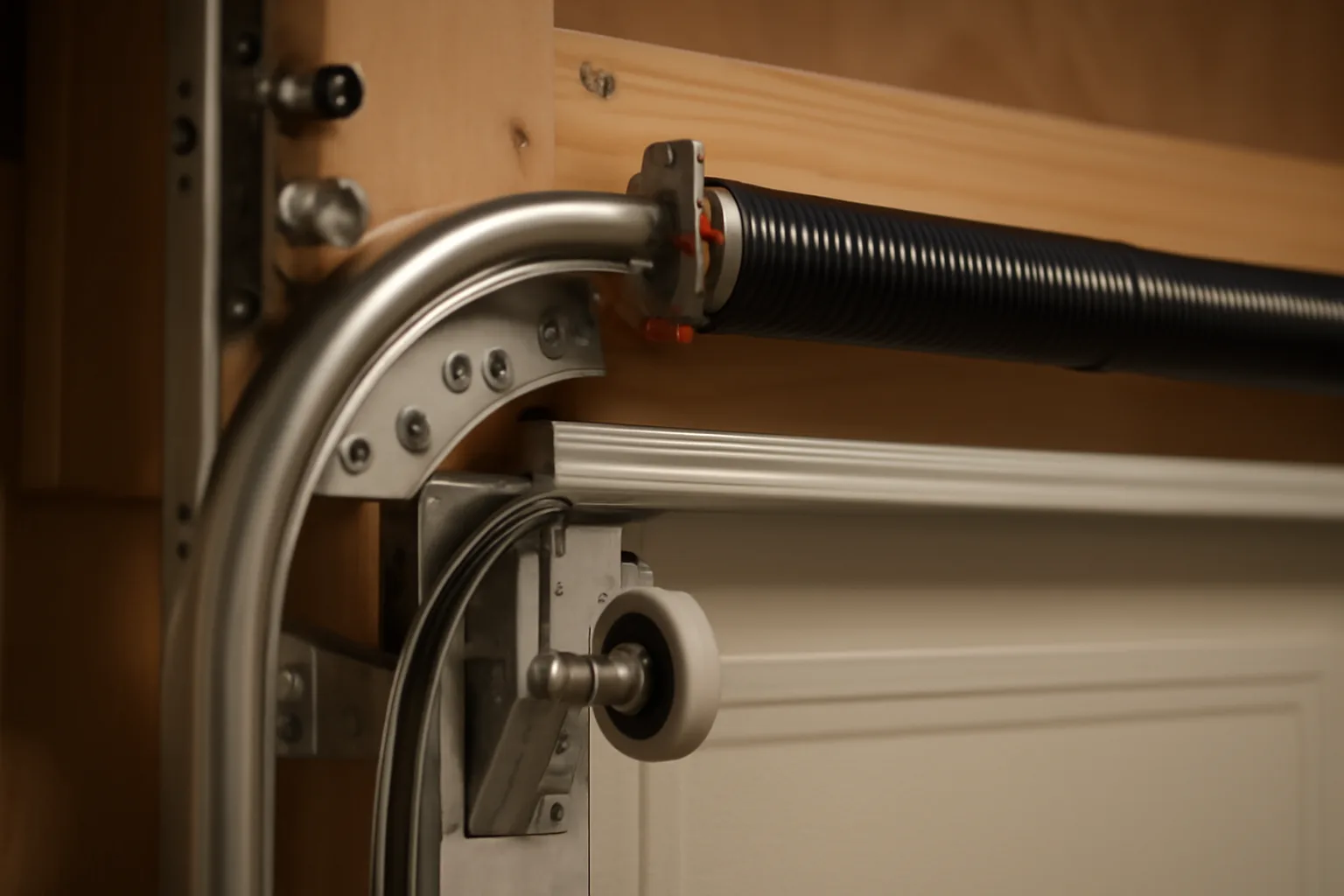
How does a garage door jump the track?
A door can jump its guiding path after impact damage, failed cable support or a worn or damaged roller and rail arrangement. Stop the controls and keep out from under raised panels; the escaped roller may follow an earlier fault that must be corrected before repositioning is a complete repair.
A Holden door off its track may have reached that position after more than one event. A rail can be struck directly, or uneven lifting support can twist the panels into the guides. A roller outside the path is the visible result, not proof that the roller began the failure. Keep ordinary controls unused and describe the position before deciding the job is only a reset.
Trace what preceded the displacement
Mention a vehicle contact, stored object near a rail or scrape that appeared during earlier cycles. Say whether one side lagged before the panels stopped. Those details help relate the condition now found to the sequence of changed movement. Do not recreate the severe catch to make the account more convincing.
Rails guide travel while cables and springs support the assisted weight. A cable no longer lifting one side appropriately can draw the door into its guiding hardware unevenly. A damaged track section can obstruct movement for another reason. The inspection should distinguish support from guiding damage and explain what remains usable in the intended correction.
Protect the route beneath the panels
Do not pass under a hanging door to reach a latch, tool or remote. Household props do not establish reliable support. Disconnecting the operating unit is also not a method of making every damaged assembly stable; without appropriate balance, the panels can move after the connection changes. Use another entry only where the route itself is safe.
Leave lower brackets, spring fittings and cables untouched. Something appearing slack can be beside other hardware that remains loaded. Pulling a cable, winding it toward a drum or using the motor to straighten the panel line does not establish controlled support. Tell other users not to send another command while service is being arranged.
Ask what the repair will include
A free written estimate should identify which work addresses the cause and which deals with resulting damage. Returning position, replacing a rail section and correcting a lifting component serve different purposes. Ask how each proposed item contributes to the finished travel rather than relying on a general alignment heading.
The cable-and-track price categories on this site separate those descriptions. A reset figure should not be read as proof that every damaged part can remain. Inspection establishes the scope. If immediate work only makes the opening secure, ask what correction is still needed before ordinary powered operation and share that restriction with the household.
Observe the completed path
At handover, ask how support and guiding were checked through opening and closing, with the relevant operator functions suited to the repaired assembly. A short lift near one end of travel does not account for every point where the earlier obstruction may have appeared. The explanation should connect the original event to the correction.
Keep the scope and selected product information. Call (774) 332-7609 if a later new tilt, lag or scrape changes your Holden door's movement. Report where it appears and when it began before another severe attempt. That account supports assessment without a household effort to push, tighten or bend the mechanism back into a straighter-looking position. Explain any changes attempted after the first failure, even if they did not improve it. That history can help separate the original displacement from the condition now present without asking anyone to reverse an unsafe intervention.
For help with this in Holden, see our garage door cable & track repair page.
For the manufacturer or safety view, see DASMA's garage door safety guidance.